I visited Chandigarh in 2012. I was staying in New Delhi and took a day trip by train. One day was not enough to see everything, but I was glad to explore some parts of this city which has become such a landmark in the history of urban planning. In this piece, I share some impressions of the places I was able to visit.

Pujab’s new capital
With India’s independence from the British Empire in 1947, the partition of India and the establishment of Pakistan, the former capital of the Punjab region (Lahore) was now part of Pakistan. East Punjab needed therefore a new capital. Initially, the idea was to adapt the government structure to an existing city, but due to the new population demand – with over 4.5 million immigrants from Pakistan – it was agreed to build a new city from scratch. That city was Chandigarh.
Once a site had been selected, urban planners were commissioned to draw up the master plan. Jawaharlal Nehru, the Prime Minister at the time, hired Albert Mayer and Matthew Nowicki. Mayer had served as a lieutenant in India during the Second World War, when he met Nehru, and had expressed his interest in working on a project for the country. They began the project, but in August 1950, his partner died in a plane crash. Mayer then declared that he could not continue the project alone and abandoned it halfway through.
Following this shock, there was a moment of indecision. Who should take on this project, overseeing the design and construction of the new capital? After various names had been discussed, the decision was made in favour of Le Corbusier.


Le Corbusier’s plan and parallels with Brasília
When visiting Chandigarh, I could not help but think about Brasília. Chandigarh (1947) and Brasília (founded in 1960) were established after the end of the Second World War, with little more than a decade between them. In both cases, it was a time of great optimism about the future. In India, this followed the end of a religious war and the partition of India and the state of Pakistan. In Brazil, it was a time of prosperity and economic development. Brasília’s urban plan followed a road-oriented model, prioritising the car as the main means of transport.


Both plans follow the principles of the 1933 Athens Charter. This is a progressive urban model in which the different zones are clearly defined and separated (residential, commercial, recreational and transport). In Chandigarh, these zones are distributed across a grid of ‘sectors’, each measuring 1,200 x 800 metres. In Brasília, we have the residential superblocks (Superquadras), measuring 240 x 240 metres.


Much like Lúcio Costa’s plan, in which the ‘Three Powers Plaza’ (Praça dos três poderes), comprising of the Palácio do Planalto (presidential office), the Federal Supreme Court and the National Congress, is positioned at the head of the complex, it is in the ‘Capitol’, at the northern end of Chandigarh, that the ‘Secretariat’, the ‘High Court’ and the Palace of Assembly are located. Although it occupies a prominent position within the urban grid, the Capitol follows its modular structure. It corresponds to the size of two sectors. In Brasília, on the other hand, the plaza is distinguished not only by its position on the plan, but by its form as well.

An artificial lake was created in Chandigarh, just as it was in Brasília. This is the city’s main leisure area.
Whilst in Brasília, a green belt runs along the residential area, in Chandigarh it crosses the city as a single green strip from north to south. A green corridor connecting green spaces, including the Rose Garden.
The commercial sector is concentrated in Sector 17. There are arcades arranged around a large square, providing a place to meet and stroll beneath the colonnades. This spatial organisation reminded me a bit of ‘Connaught Place’, in New Delhi.

Rationalism Meets Local Culture


Chandigarh’s public spaces are well-organised and well-preserved. I spotted plenty of litter bins on the streets, as well as bicycle racks and signage. Despite the rationalist approach in the design, the inhabited spaces often reveal unexpected uses which responds to the local culture and necessities. Here in Chandigarh, for example, some of the bus stops have been used as places to tether cows.


At the Capitol, beneath the Open Hand monument, I saw some staff members making the most of the open space to play a game of ‘cricket’ during their lunch break.
Does Le Corbusier’s plan translate into a better quality of life for Chandigarh’s residents? Chandigarh is a city of 1 million inhabitants, smaller in comparison to Mumbai (12 million), Delhi (11 million) or Bangalore (8 million). Maybe its smooth functioning is a result of its reduced scale, or perhaps it is also due to the city’s optimism, ingrained since its conception.

Addendum 2026:
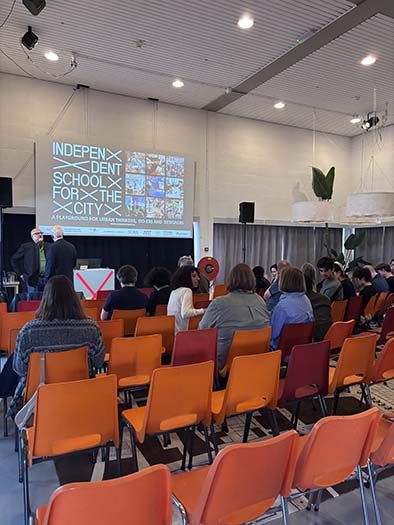
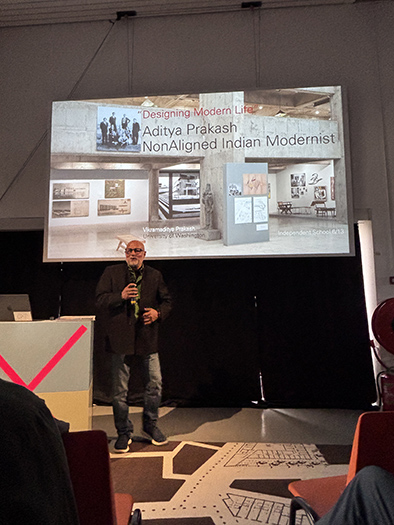
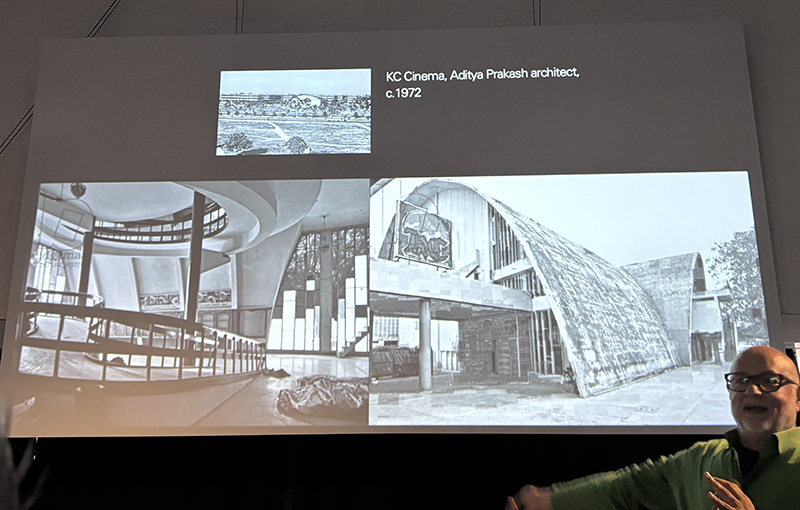
On June 13, I attended a lecture by Vikram Prakash at the Independent School for the City, in Rotterdam. He is a Professor of Architecture at the University of Washington and son of Aditya Prakash (1924-2008), an architect who worked together with Le Corbusier in Chandigarh. He designed many of the city’s buidings, like the architecture school, the KC Cinema and the Tagore theatre, to name a few. According to Vikram Prakash, the Chandigarh project not only embodied a vision of a new India following independence from the British Empire, but it sought to create a new international identity that went beyond the East-West, capitalist-communist, local-regional binaries. This was called the ‘Non-Aligned Modernism’ movement.